News
LCA study of REC thermoplastic compounds
Novalca’s REC compounds, produced with post-industrial recycled polymer raw material, reduce the Carbon Footprint by up to 62% compared to virgin polymers. This is demonstrated by the LCA study, conducted according to ISO 14067:2018 by an accredited body.
The range includes Novakral® REC (ABS), Novalux® REC (PC) and Novablend® REC (PC/ABS).
What is the LCA study conducted by Novalca
LCA (Life Cycle Assessment) is the scientific methodology used to measure the environmental impact of a product throughout its entire life cycle. When the analysis focuses on greenhouse gas emissions, it specifically refers to the product Carbon Footprint, regulated by the international standard ISO 14067:2018.
Novalca commissioned an accredited body to carry out an LCA study with a cradle-to-gate approach (from the extraction of raw materials to the compound leaving our production plant) on its most representative formulations. The objective: to transparently and verifiably quantify how much REC compounds reduce CO₂ equivalent emissions compared to the corresponding virgin compounds.
The results: up to -62% CO₂ emissions
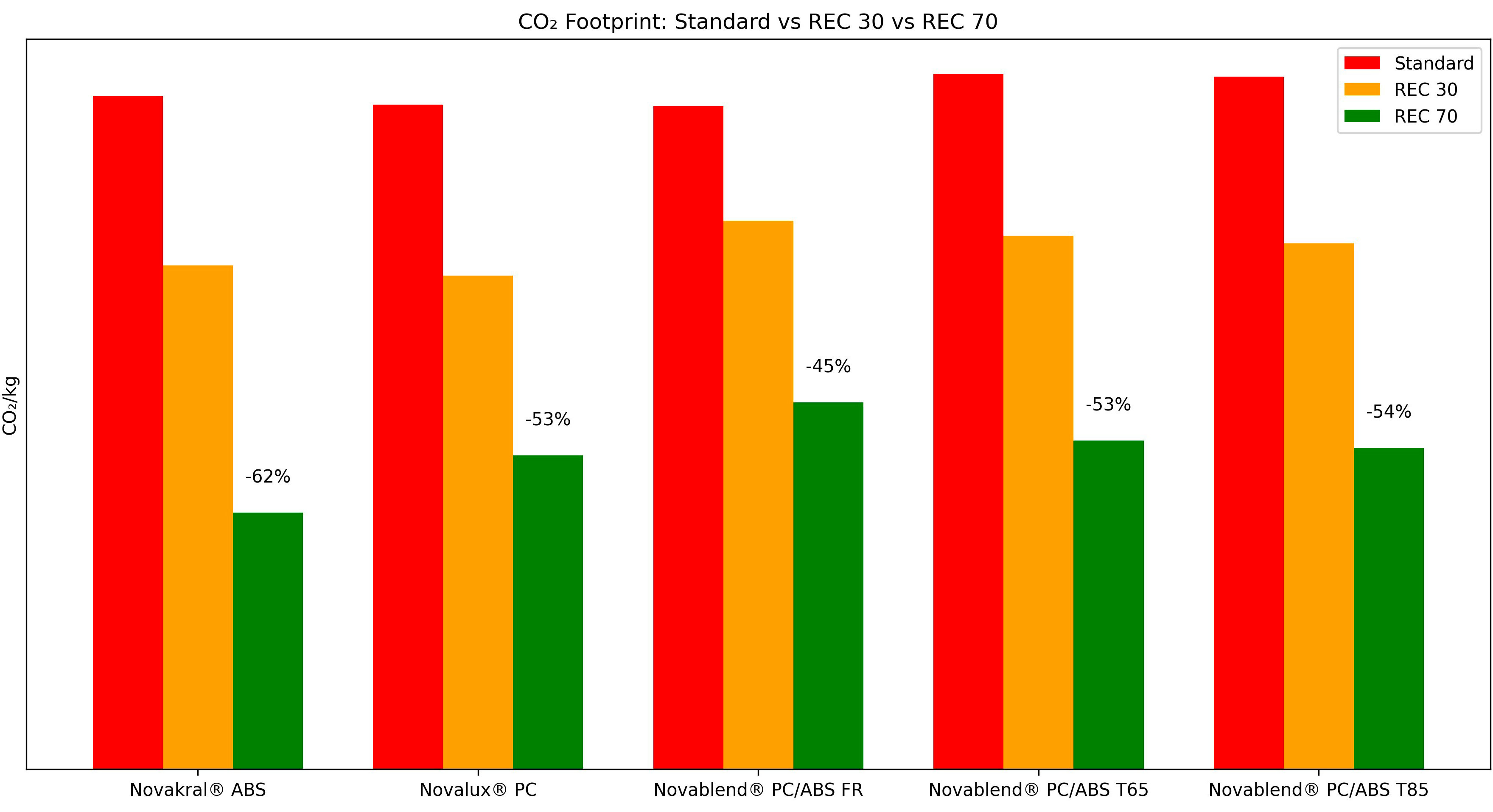
The LCA study shows that the use of post-industrial recycled raw material (PIR) enables a significant reduction in climate impact across the entire range analysed. The most relevant result concerns the comparison between Novakral® REC R70 and virgin Novakral® ABS: a 62% reduction in CO₂ equivalent emissions, with the same mechanical and thermal performance.
Novakral® REC R70 vs virgin Novakral® ABS
Novakral® REC R70, an ABS compound containing 70% recycled raw material, reduces greenhouse gas emissions by 62% compared to virgin Novakral® ABS.
Novalux® REC and Novablend® PC/ABS REC
The reductions are confirmed across all the compound families analysed. Percentages vary depending on the recycled content (from 30% to 70%) and the base polymer matrix, but the trend is constant: the higher the PIR content, the greater the reduction in Carbon Footprint.
| Family | REC version | CO₂ reduction |
|---|---|---|
| Novakral | REC R70 | up to -62% |
| Novalux | REC R70 | up to -53% |
| Novablend | REC R70 | up to -54% |
Why virgin raw materials account for up to 89% of the Carbon Footprint
The study highlights a key finding for those developing technical plastic products: the largest share of emissions from a thermoplastic compound does not come from the processing stage, but from the production of the virgin polymer. In the compounds analysed, virgin polymer raw material accounts for up to 89% of the total Carbon Footprint.
The most effective lever for reducing the climate impact of a technical plastic component is therefore to replace, at least in part, the virgin polymer with recycled raw material of controlled quality. This is exactly what Novalca’s REC compounds do.
REC compounds: equivalent performance, reduced impact
REC Compounds (Recycled Engineering Compounds) are technical thermoplastic compounds containing from 30% to 70% post-industrial recycled raw material (PIR). They are produced in compliance with ISO 14021:2016 on self-declared environmental claims and, for the most widely used formulations, validated by TÜV.
Unlike post-consumer materials, PIR comes from selected and traceable industrial waste, which retains physical, mechanical and thermal characteristics comparable to those of virgin polymer. This allows REC compounds to be used even in technically demanding applications without compromising performance.
Novalca since 1976: sustainable thermoplastic compounds
Since 1976, Novalca has been developing custom thermoplastic compounds in its three Italian production sites. The LCA study published on this page is an integral part of our commitment to: ISO 9001:2015 certified quality, environmental transparency according to ISO 14021:2016, responsible use of raw materials and measurable reduction of climate impact.
